

About
Author Coni Koepfinger
Playwright, Librettist, Artist and Educator, Coni Ciongoli Koepfinger is a playwright - in - residence at both Manhattan Repertory Theatre and Cosmic Orchid Theatre Company. As the creative director and host of AIRPlay with the On Air Players, Koepfinger brings the voices of artists, actors, playwrights from all over the world together in her weekly virtual theatre radio program. Also via new media, Koepfinger has created DETERMINED WOMEN, a monthly feature the interviews Today's Theatre Women who share their stories to encourage and inspire.
In addition to teaching theatre and composition at Carnegie Mellon and various universities, Koepfinger is an internationally published and produced playwright and librettist. She also is a contributing writer for the Center of Conscious Creativity in LA; a board member of the International Center for Women Playwrights; the Media Arts Advisory Board of Lifeboat Foundation, recently published GET THE MESSAGE in their new Visions of the Future anthology 2016; a Member of The Dramatists Guild, and the League of Professional Theatre Women. Recent work includes three new powerful pieces with her writing partner Joe Izen: including "The Eve of Beltane" -a fresh look at political corruption in the face of ancient Celtic mythology; "Schoolhouse" an ultra modern musical that takes the young Ella, a victim of a school shooting through a journey into an imaginary schoolhouse to find compassion and joy awaiting; and " KINGDOM COME" where technology meets it's match in matchmaking with TED, the first trans-human who falls in love with boss only to reveal a brighter picture for all.


Waking Up in the Spotlight with
“The Unusual Chauncey Faust”
Written by Alexander Fatouros | 24th Mar 2026 | New York, Review, Theatre and Art, United States of America
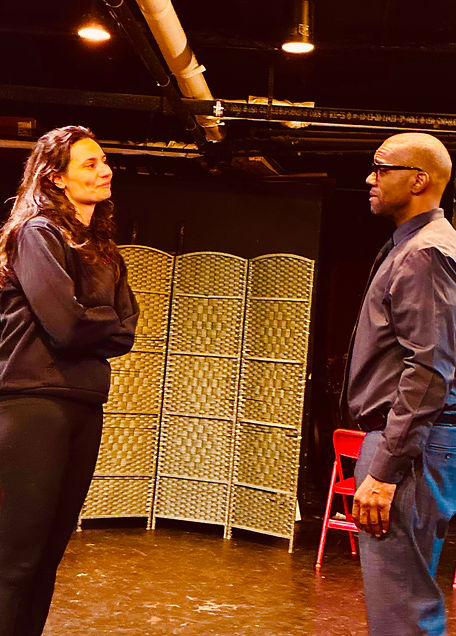
Will Lippman as Dr. Stanley Morgan and Sean Ricciardi in "The Unusual Chauncey Faust" at The Gene Frankel Theatre. Photo credit: Reza Mirjalili. Review by Alexander Fatouros
If you’ve ever felt like you were just playing a part in your own life—waiting for a big break or a magic potion to finally make you feel successful—then Coni Koepfinger’s The Unusual Chauncey Faust, now playing at the Gene Frankel Theatre at 24 Bond Street in New York City, will feel startlingly familiar.
Fresh off its first-place victory at the 15 Minutes of Frame competition, this expanded full-length play is more than just a stage comedy; it is a meta-theatrical mirror held up to our modern obsession with shortcuts and curated identities.
Presented by 24 Bond Arts Center and Lucky’s Lighting Inc. and directed by Aviva Katz, this production written by playwright Coni Koepfinger reimagines the Faustian myth through the lens of a modern actor who feels time slipping away. Portrayed by Sean Ricciardi (March 18 – 26) and Kenny Harmon (March 27 – 29), Chauncey is driven by a purpose beyond mere ambition. His journey takes a sharp, surreal turn when he is diverted from an audition into a psychiatric institution, sparking a fragmented struggle to reclaim the life he imagines for himself.
Hilal Koyuncu as Dr. Maria Olon and Sean Ricciardi as Chauncey Faust. Photo credit: Reza Mirjalili
At its heart, the play explores the internal director—that part of us that finally steps back from the script and asks if we actually want to say these lines. Drawing from the philosophy of Maria Olon Tsaroucha, Chauncey is driven by a deep hunger for purpose, but he is tempted by a system that promises elevation without the hard work of inner growth. He is a man who feels his life is just a series of scenes he didn’t write, trapped in the actor persona—the version of ourselves we show the world through social media, our roles, and our labels. The story asks if we are the authors of our own lives or just following a script because it is easier than being ourselves. It is a battle to stay awake and authentic in a world that constantly tries to automate who we are, turning the stage into a mirror for anyone who has ever felt like a passenger in their own life.
Will Lippman and Sean Ricciardi. Photo credit: Reza Mirjalil
Sean Ricciardi, Will Lippmann, and Emerick King. Photo credit: Reza Mirjalil
The potion in the play serves as a potent metaphor for the temptation to outsource our becoming, a poetic point that relates back to the original legend. It highlights the dream: being on autopilot and chasing money, fame, distinction, or validation. As Chauncey is diverted from an audition into this clinical purgatory, his journey becomes a struggle to see the world without the software running in the background. This is essentially about mindfulness or self-awareness—a waking up inside the dream. A major theme here is the witnessing of intelligence, which is the ability to choose one’s identity consciously rather than performing it unconsciously. Ultimately, Coni Koepfinger has her finger on the pulse of the modern identity crisis, showing us that moment of realizing the ladders we climb might be leaning against the wrong wall.
Sean Ricciardi as Chauncey Faust and Will Lippman as Dr. Stanley Morgan in The Unusual Chauncey Faust. Photo credit: Reza Mirjalili
The chemistry of the ensemble, under the direction of Aviva Katz, keeps the audience leaning in even as the boundaries between reality and performance overlap. Will Lippman (Dr. Stanley Morgan) and Emerick King (Ms. Candice Appleby) provide sharp counterpoints to Chauncey’s existential crisis, grounding the surreal framework of the script with engaging, professional performances. Hilal Koyuncu, portraying Dr. Maria Olon, brings a stark intensity to the stage, serving as a vital anchor in the fragmented world of the institution. Together with Kendra MacDevitt (Avery Mello), the cast keeps the stakes high, forcing Chauncey to confront his choices within this tight-knit, high-energy collective.
Sean Ricciardi and Kenny Harmon in The Unusual Chauncey Faust. Photo credit: Gail Thacker
The production’s atmosphere is essential to its meta feel, crafted by a cohesive artistic team. The scenic design by Joelle Gonzalez and the lighting by Lucky’s Lighting Inc. create a world that feels both intimate and expansive—a dreamscape that shifts at any moment. With Bekah Lazar as stage manager, these transitions feel seamless; when the temptation of the shortcut appears, the lighting shifts into a striking, otherworldly glow, visually signaling the moment the software of the system takes over. The sound design by Andy Cohan, paired with Joe Izen’s original music and orchestrated by Kendra MacDevitt, acts as the play’s heartbeat. Under the artistic direction of Gail Thacker, these elements subtly underscore the tension between Chauncey’s ambition and his need for a breakthrough—that moment where the actor finally stops performing and starts witnessing his own life.
In an era where we are constantly pressured to brand ourselves for an audience, The Unusual Chauncey Faust arrives at the Gene Frankel Theatre for a limited run from March 18 through March 29. It is a timely and deeply necessary wake-up call. It is a journey from autopilot to awareness that mirrors the very relatable modern struggle to stay real in a world that is increasingly simulated.
The iconic Gene Frankel Theatre at 24 Bond St. in downtown Manhattan. Photo By Alexander Fatouros
From left to right Back row: Coni Koepfinger, Will Lippman, Hilal Koyuncu, Maria Olon, Bekah Lazar, Joelle Gonzalez. Center: Sean Ricciardi, Aviva Katz, Kenny Harmon. Floor: Kendra MacDevitt, Emerick King. Photo credit: Andy Cohan
This production is a rare find in the indie theatre scene: a play that manages to be hilariously absurd while carrying the weight of a philosophical provocation. It doesn’t just ask if the dream is real; it asks if you are brave enough to be the author of it. Whether you are a fan of avant-garde theatre or simply looking for a story that makes you think twice about your own daily script, this is a must-see. You’ll walk out of the Gene Frankel Theatre wondering if you’re finally ready to take the lead in your own story.
Review by © 2026 Alexander Fatouros. Editor, The Theatre Times
This post was written by the author in their personal capacity.The opinions expressed in this article are the author’s own and do not reflect the view of The Theatre Times, their staff or collaborators.


The Unusual Chauncey Faust
Opens March 19- 29, 2026
Thursday-Sunday
The Gene Frankel Theatre
Greenwich Village
A CRITICAL ANALYSIS
When I first read Coni Koepfinger’s The Unusual Chauncey Faust, I felt an immediate recognition. Beneath its surreal humor and theatrical absurdity lives a profound question about our time: who authors the dream we are living?
Chauncey stands at the edge of ambition, longing for success, visibility, financial freedom — and he is offered something seductive. A system. A shortcut. A promise of transcendence without inner awakening. A manufactured elevation of the self. The “potion” in the play may be imaginary, yet what it represents is very real: the temptation to outsource our becoming.
Koepfinger brilliantly exposes the fragility of identity when it is built on external validation. Chauncey is not unstable; he is unanchored. He is searching for a role large enough to contain his hunger, without realizing that the deeper question is not “How do I rise?” but “From where am I rising?”
This is where the Supraconscious breakthrough becomes essential. The Supraconscious layer — the observing intelligence within us — is the part of the self that can witness thought, emotion, ambition, and fear without being ruled by them. It is the capacity to choose identity consciously rather than perform it unconsciously. In a world increasingly fascinated with engineered realities, curated personas, and orchestrated experiences, this inner authorship becomes evolutionary.
In Chauncey’s world, dream-architects design the experience and the individual steps inside it. The danger is subtle: transcendence without responsibility. Expansion without awareness. Performance without perception.
The Supraconscious shift is different. It is not about escaping reality or enhancing illusion. It is about awakening inside the dream and recognizing that the rope, the elevator, the injection — the forces that appear to bind or elevate us — are not the true source of power. The true source is the witness who chooses the scene. Koepfinger’s play operates as meta-theatre, exposing the mechanics of illusion. The Supraconscious perspective goes one step further — into meta-identity — where illusion itself becomes a conscious instrument rather than an unconscious trap.
What feels so timely about The Unusual Chauncey Faust is that we are entering an era where perception can be manipulated at scale. Technology is learning to simulate experience, alter narratives, and construct digital dreamscapes. Without an inner anchor, ambition becomes vulnerable to seduction. With supraconscious awareness, ambition becomes refined, ethical, and aligned.
Chauncey’s journey is not merely comic or tragic. It is archetypal. It mirrors the moment each of us faces: whether to surrender authorship for the illusion of instant elevation, or to rise through awareness.
And perhaps that is why this play resonates so deeply. It does not simply ask whether the dream is real.
It asks whether we are awake inside it.
Maria Olon Tsaroucha
Artist/ Founder of Supraconscious You
Maria Olon-Tsaroucha
Author & Thought-Leader Keynote Speaker |
Founder and CEO Supraconscious You |
Artist-Researcher & Futurist
AMERICAN THEATRE OF ACTORS
314 West 54th St. New York, NY


New York playwright Wilber Weinberg is having a hard time coping. His wife Candice accepted a huge promotion in Silicon Valley. To help, Candice sends Wilber a unique gift– a very talented AI named Goldie. She is a tech-mate who is proficient at just about everything. When director Ben Garrison asks Goldie to help “revise” Wilber’s new scenes, everyone is amazed at her talent. everyone except Wilber that is. He feels threatened. Consumed by jealousy, Wilber starts self-medicating with vodka tonics. At intermission for the opening of his new play, the inebriated Wilber threatens to stop the show, claiming it is not his work anymore. What’s worse is when Ben confides to Wilber that he is in love with Goldie, Wilber announces that he’s going to dismantle her, pack her up, and sell her on Ebay.
-
Cast Size: 3M 3W
-
Running Time: 90+ minutes
-
Royalty Rate: $75 per performance
REVIEW
Get real with AI, ATA, and Wilbur’s New WiFE
The idea of an ex-partner programming a new AI creation to be what she can’t be for her former love is a clever, disturbing, and very timely one. Goldie’s beauty, charm, and intellect are off the charts, but one can’t ignore the brutal truth—that she is still a fabrication, a parody of a human being whose feelings and artistic “depth” were created with a few keystrokes. It’s something that hits powerfully home in an age where we can get our favorite singers and actors to do whatever we want through Deep Fakes, De-Aging, and Voice Recreation. (And we can even create fake companions that will tell us what we want to hear, so Candace is checking all the boxes here.)
Goldie is tailor-made for Wilber in every way, but ironically Wilber comes to realize that she is better suited for his friend and director, Ben (Alan Hasnas), who quickly becomes smitten with the hybrid. This twist is a devastating one for anyone familiar with unrequited love—Wilber can’t even hang on to the love of an artificial being specifically created for him!
But the show must go on, and Goldie joins Wilber and Ben in working on their new play. When they get stuck, she is pressed into action, and rewrites the script in a matter of seconds—her “thoughts” attached directly to the whirring printer in the rehearsal room. It’s a funny but chilling representation of how we’re beginning to surrender our creative choices to the likes of ChatGPT.
In an intensely funny and thought-provoking sequence, Wilber’s actors (Mady Huston and Riyadh Rollins) do different versions of Wilber’s play in the style of famous playwrights. Just like ChatGPT, Goldie is programmed to simply mimic the writing of the greats by scanning through their works and coming up with something “new”—but soulless. Despite Candace’s claims that Goldie “has” a soul, the hollow falseness of the situation is palpable.
Candace eventually returns to see the results of her experiment, and eventually old-fashioned emotion and genuine feeling are returned to the lives of our characters. But we are still left with the lingering threat of AI, and reminded to hang on to our hearts and our creative spirit for dear life.
Wilber’s New Wife is just what we need right now as we reach a pivotal point in human development. Koepfinger and her charming and talented cast have truly given us something profound to think about as we speed into the 2nd quarter of the 21stcentury, and an uncertain future—both for the Arts, and for how we live and love.
Jim Capatano, New York City Theatre Critic, November 29, 2024

Social Insecurity by Coni Koepfinger
Directed by Byron C. Saunders and Jon Hayden
Starring Paul Eisemann and Patricia Van Tassel
with Ken Coughlin, Jon Hayden, Sabrina Morabito
THE WORLD PREMIERE
August 4-6, 2025
Koepfinger's newest play, Social Insecurity, explores the power of art to heal by holding a mirror up to the ills of society that cause us daily anxiety. In this metatheatre fantasy, playwright Michael falls for the leading lady, Patricia, Meanwhile director Harvey Hanger sees this as an opportunity to get control over the play and the writer's immense fortune from his recent inheritance. Harvey hires Stranger Sonny, an actor, to stage a robbery in the theatre, assaulting Michael and Patricia, who by the way, recently were wed in real life. As expected, the drama soon gets out of control, on an on and off stage but in the end, love conquers all.

Joe Izen and Coni Koepfinger’s
THE EVE OF BELTANE
A Tale of Celtic Magic and Reincarnated Love
It is the night before the Celtic Festival of Beltane, an ancient May Day ritual, a time when the otherworldly cast is close at hand. Druids march as dark spirits rise in shadow only to be squelched by the brilliance of the light. Young maidens hang the festive boughs while the boys, blindfolded, meet on the drumlins, eating the ember cakes marked with charcoal. Here, one unlucky fellow, with the stained piece will have to leap the flames of the bonfire three times to please the ancient tradition.
Behind the cheering gaiety, two voices are heard crying out to each other. The flame of a lantern shows Jenny and Johnny, as they huddle together in a churchyard attempting to make an escape from her father's henchmen. Their love is forbidden.
"The Eve of Beltane" then jumps centuries into the present, where Jenny and Johnny meet again as college students at Notre Dame. While their reincarnated spirits seek to consummate their love, Jenny's father, Derry O'Leary still stands in their way refusing to allow his daughter to marry beneath her. Enter Dr. Kelson O'Leary, a transmigrated Merlin, who recognizes the gravity of true love. Now when Jenny brings Johnny home, the crafty professor of myth and magic helps to align the stars that allow Derry to see the fire of love that burns beyond all worldly limitation. This metaphysical fantasy explores themes of eternal love, destiny, and Celtic magic.

Theatre
The Art of Collabotation
Theatre Pure and Simple

Actors & Directors


In spiration...
The reality of LOVE & Truth


Formatives Stages
Analyzing the Stages of Creative Form Koepfinger’s Pedagogy
Theatre Production Text Proposal
Date: March 27, 2011
Title of Text: Formative Stages: Accessing the Stages of Creative Form for Production
Authors : Constance Koepfinger, MA - Carnegie Mellon University
Jay Breckenridge, DA. - The Pennsylvania State University
After years of collaboration and team teaching, Dr. Breckenridge and I have designed a new methodology for structuring a course that makes stage production more accessible to students and faculty at every level of expertise. Whether the desired result is to create an original production from a real life current event, an episodic folktale, or a tried and true play script, formative stages examines the stages of creative form at three very identifiable phases of formation . By using the split, spin, spiral pedagogy, three distinct formations will emerge.
STAGE ONE – SPLIT FORMATION: Understanding that before embarking on any creative project, one must recognize the split from source material and preconceived ideas in order to originate fresh ideas and thus create something innovative and distinct from the source material. Sample Task : preparation for exploration into the life and times of the storyteller—Students will research the background by reading biographical info and forming a BIO – Analysis Strip before the play is even introduced.
STAGE TWO- SPIN FORMATION: Once the split is established, the initiator (writer / performer) must energize the new ideas by putting their own particular spin on the text to give it form so that it can be acknowledged by an outside receptor (reader/ spectator) Sample Task: Preparation for Improvisation of initial scenes. By studying key scenes in detail, students will understand the necessity of careful placement and clarity when using rhetorical strategies, helping to capture thought and sound patterns of language that will bring to life even the most abstract concept.
STAGE THREE- SPIRAL FORMATION: After the raw creative forms are launched to the receiver, a signal of acceptance must occur, and thus the initiator waits for recognition as the new forms spiral back. Sample Task: Preparation for Performance—The Perfection of Form. All the elements are brought together by the final production, followed by review or appreciation of the play in the form of a talk- back session with an invited audience, including the original storytellers.
Formative Stages has been presented at two major conferences: The 2006 Hawaii International Conference on Arts and Humanities in Honolulu and The 8th National Symposium on Theater in Academe at Washington and Lee University. Both times, the interest factor from our academic colleagues was very high. Therefore, we have proposed to document our process of discovery in this text. We feel that this new pedagogy is a useful methodo not only for practitioners in theatrical studies but also for colleagues in other fields as well, where the stage resources maybe limited.
Formative Stages, a new methodology to the process of staging a play, also chronicles a fresh approach to recording, reporting and revisiting creative information. As partners in education, we enter the golden gates of the new era that is bombarded with a deluge of ideas from the past, present--- and oddly enough the future. Therefore it only seems natural that new pedagogies must begin to emerge in order to keep today’s student actively engaged in the evolution of his discipline. For only then will the seeds of higher education begin to sprout and develop as new and better ideas fruit in the cultural harvests of tomorrow .


MetaTheatreLINKS
"The Greeks believed that theatre was threefold: to entertain, to educate, and exalt the human spirit. And if we’re going to exalt the human spirit we’re gonna have to understand that we can only do that through love.” ~Coni Koepfinger
Artistic Director Ken Wolf talks Coni as Playwright-In- Residence on her process
Dan Carter and Coni talk about their new play, AUTIONING FOR ETERNITY that opens at Theater for the New City
INTERVIEW w/ ARTS INDEPENDENT
Coni Talks with the legendary actor, director about his new projects and how they evolved
Auditioning for Eternity - Theater for the New City 2022
by Coni Koepfinger and Dan Carter
REVIEW by CHRIS STRUCK Koepfinger’s play AFTERLIFE The Secret Theatre 2017 directed by JOAN KANE
starring Lani Cataldi and Stark Wilz


Published Plays
The Theatre of the Awakened Dream brings stories to life with depth and emotion. Our plays ignite imagination and provide a platform for introspection. Dive into a world where reality and fantasy intertwine to create unforgettable theatrical experiences.
Next Stage Press Titles
• Coffeehouse Magik by Coni Koepfinger
• Josie in the Bardo by Coni Koepfinger
• The Fortune Teller by Coni Koepfinger
• My Dinner with Mary by Coni Koepfinger
• The Rudolph Plays by Coni Koepfinger
• Spotlight Therapy by Coni Koepfinger
• POLLYANNA- Adaptation of the Eleanor Porter Classic
by Coni Koepfinger and C.Michael Perry
• Sundiata, the Legendary Lion King of Mali
by Coni Koepfinger and Dr. Jay Breckenridge
Leicester Bay Theatricals Titles
-
CandleDancing — The Voice of Julian of Norwich by Coni Koepfinger, Requiem and Score by Robert Hugill
-
Get The Message – A 10-minute play
-
NEW! LITTLE PRINCESS: SARA CREWE: by Coni Koepfinger and C. Michael Perry [based on the Frances Hodgeson Burnett novel]
-
Off The Path – A 10-minute play
-
NEW! POLLYANNA by Coni Koepfinger and C. Michael Perry [based on the Eleanor Porter novel]
-
NEW! THE SAGA OF SASQUATCH C’LONE by Jon Robert Howe, Coni Koepfinger and C. Michael Perry
-
NEW! THE SHADOW DANCERS The Musical for a New Millennium by Coni Koepfinger & C. Michael Perry
-
TINKERTOWN! — Where Creativity Comes to Life! TYA -Book/Lyrics by Coni Koepfinger, Lyrics/Music by C. Michael Perry
